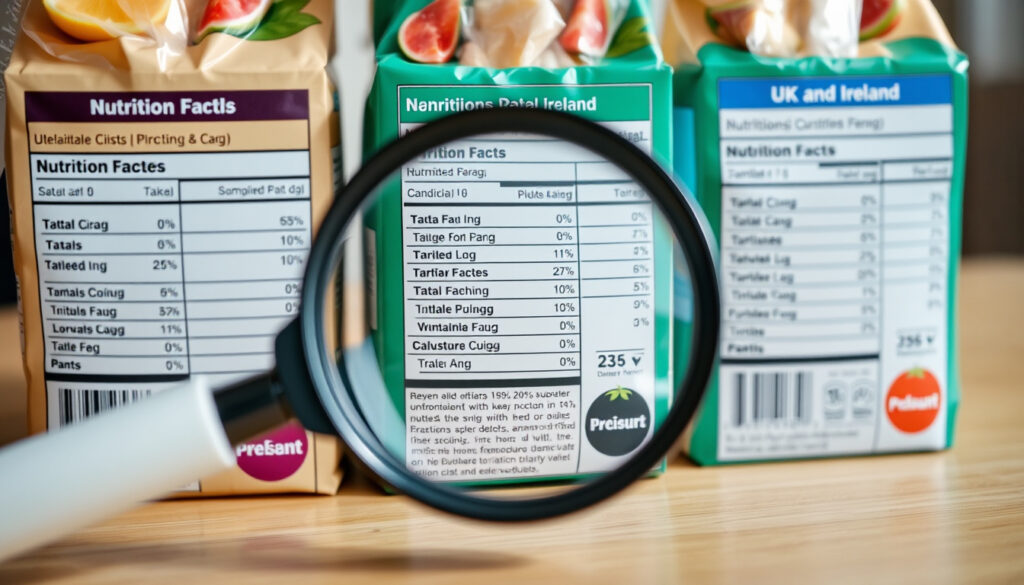
How to Read Nutrition Labels: US, UK & Ireland Guide
You’ve stood in the supermarket aisle, turned a package over, and stared at a grid of numbers that may as well be in a foreign language. Nearly every country’s food label contains the same core facts — serving size, calories, fat, salt, and sugar — but the rules for interpreting them shift depending on whether you’re in the US, the UK, or Ireland. Here is how to break down how to read nutrition labels from three different regulatory systems, so you can walk into any shop and know exactly what you’re looking at.
Serving size Starting point for all nutrient values ·
Daily Value (DV) 5% or less is low, 20% or more is high ·
5/20 rule Quick benchmark for nutrient limits ·
Calories per serving Energy amount for one serving
Quick snapshot
- Optimal daily value percentages vary by individual health condition (American Heart Association)
- Exact cutoff for ‘high’ cholesterol (7.8 mmol/L) depends on overall risk profile (CDC)
- FDA label design overhaul in 2016 introduced added sugars line (FDA)
- UK traffic light system voluntary since 2013 but now used on ~80% of packaged foods (PMC / NIH article)
- EU mandatory front-of-pack nutrition labelling (Nutri-Score) may align systems
- WHO calling for global standardisation of serving size definitions
These four values are the anchors of any nutrition label discussion.
| Label | Value | Source |
|---|---|---|
| FDA label update year | 2016 | FDA |
| High sugar threshold | >22.5g per 100g | NHS (UK) |
| High salt threshold | >1.5g per 100g | NHS (UK) |
| Daily value for saturated fat (2000 cal diet) | 20g | FDA |
How to read a nutrition label for beginners?
One cup of ice cream labeled as a single serving looks small — but if you eat the whole pint, you’ve quadrupled every number on the label. Serving size is the hidden amplifier no one talks about.
- Check serving size
- Check calories
- Understand % Daily Value
- Limit fats, salt, and sugar
Start with serving size
- The serving size is the foundation. The CDC says it reflects what people typically eat, not what they should eat — and instances like a ⅔ cup serving of ice cream or a 12-ounce soda bottle labeled as one serving show how actual portions can differ (CDC). The American Heart Association adds that if you eat two servings, you double all the nutrient numbers (American Heart Association).
- In the US, serving sizes were updated in 2016 to match what people actually consume, per the FDA’s own data. The FDA notes that serving sizes are now based on amounts customarily consumed in one sitting (PMC / NIH article).
Check calories
- Calories tell you the energy per serving. On a 2000-calorie diet, a snack providing 400 calories is 20% of your daily intake. The calculation is straightforward — 1 kcal equals 1 Calorie, and both mean 1000 small calories. Most food labels in the US, UK, and Ireland use kcal (CDC).
Understand % Daily Value
- The %DV shows how much a nutrient in one serving contributes to a total daily diet. According to the FDA, 5% or less per serving is considered low, and 20% or more is high (FDA). The American Heart Association says to use this rule to choose foods: 5% or less if you want less of a nutrient (like saturated fat), 20% or more if you want more (like fiber) (American Heart Association).
- The CDC reinforces that Daily Values are recommended intake amounts, and %DV is a shortcut to see if a food is high or low in a specific nutrient (CDC).
Limit fats, salt, and sugar
- The NHS in the UK sets thresholds: high fat is more than 17.5g per 100g, high sugar is more than 22.5g per 100g, and high salt is more than 1.5g per 100g (NHS (UK)).
- In the US, the FDA’s %DV approach gives a percentage rather than a gram threshold — but the principle is the same: low is 5% DV or less, high is 20% DV or more (FDA).
The pattern: every regulator starts with serving size, but the thresholds differ — and so does the risk of being misled. For anyone managing weight or chronic conditions, the serving size row is the only honest starting point.
What is the 5/20 rule when reading a food package?
How to use the 5/20 rule
- The 5/20 rule is a practical tool: 5% DV or less per serving means the food is low in that nutrient; 20% DV or more means it’s high. The FDA states this directly in their Daily Value guide (FDA). CNBC reported in 2024 that dietitians commonly frame the 5/20 rule as a quick mental shortcut (CNBC).
- Dietitians suggest using the rule for fat, saturated fat, sodium, and added sugars. If the %DV for saturated fat is 18%, that’s nearly high (close to 20%). If it’s 4%, it’s low. The rule works best when you apply it to nutrients you want to limit (American Heart Association).
Examples of applying the rule
- Cereal with 10% DV for fiber: per the rule, it’s not low and not high — in the middle, so a moderate source. A yogurt with 2% DV for calcium: low. The Penn NEMS guide repeats the same principle: 5% or less is low, 20% or more is high (Penn NEMS).
What this means: the 5/20 rule gives you a decision threshold in under five seconds — but only if you already know which nutrients you should limit and which you should seek. That’s where regional label differences start to matter.
Is 200 kcal the same as 200 calories?
Kilocalories vs calories explained
- Yes — 200 kcal equals 200 Calories (capital C), which equals 200,000 small calories (lowercase c). The dietetics tradition uses “calorie” to mean kilocalorie. The British Dietetic Association clarifies that labels show calories as kcal, which is the standard unit (British Dietetic Association).
- In the US, the Nutrition Facts panel uses “Calories,” defined as kilocalories. In the UK and Ireland, you’ll see “kcal” or “kJ” (kilojoules). The difference is purely a unit label — the actual energy is identical (CDC).
Why labels use kcal
- Using kcal avoids writing all those zeros. One gram of fat provides about 9 kcal; one gram of carbohydrate provides about 4 kcal. The European Union mandates energy must always be shown per 100g or 100ml, with the option of per-serving values (PMC / NIH article).
The trade-off: a 250-kcal snack bar gets eaten in 90 seconds but takes 30 minutes of brisk walking to burn off. The unit conversion isn’t the misleading part — portion size is.
What to look for in nutrition facts for high cholesterol?
For anyone with high cholesterol, the most dangerous line on the label is often hiding in plain sight under “saturated fat” — not total fat. The American Heart Association says to limit saturated fat to less than 6% of daily calories, and a single pastry can blow that limit.
Check saturated fat and trans fat
- Saturated fat directly raises LDL cholesterol. The American Heart Association recommends keeping saturated fat to less than 6% of total daily calories — that’s about 13 grams on a 2000-calorie diet (American Heart Association). The FDA’s Daily Value for saturated fat on a 2000-calorie diet is 20g per day (FDA).
- Trans fat should be as low as possible. In the US, the FDA banned partially hydrogenated oils, the main source of artificial trans fat, in 2018. The American Heart Association says any trans fat on the label — even 0.5g per serving — is too much if you eat multiple servings (American Heart Association).
Focus on fiber and unsaturated fats
- Look for 20% DV or more of dietary fiber per serving — that’s high. Soluble fiber, found in oats, barley, and beans, specifically helps lower LDL cholesterol (CDC).
- Unsaturated fats — monounsaturated and polyunsaturated — are not required to be listed on US labels, though many brands show them voluntarily. The American Heart Association advises choosing foods with more unsaturated than saturated fat (American Heart Association).
“Saturated fat should be limited to less than 6% of total daily calories.”
— American Heart Association
For someone with high cholesterol, the implication is direct: saturated fat is the number to track, and 5% DV per serving is the cutoff. A seemingly “healthy” granola bar can deliver 30% DV of saturated fat if eaten as a pair.
How to read food labels in Ireland?
Irish shoppers face a paradox: the traffic light system is voluntary, yet over 80% of packaged goods now carry it. The red light is a warning, not a ban — but most shoppers still interpret a single red light as “unhealthy,” even when the overall nutrient profile is reasonable.
Traffic light system explained
- Ireland uses a color-coded front-of-pack system: red means high, amber means medium, green means low. The colors are based on nutrient levels per 100g or 100ml (GNTC Ireland). A study in the journal Nutrients confirmed this voluntary system is applied to about 80% of packaged food in the UK and Ireland (PMC / NIH article).
- safefood Ireland recommends using the per 100g column to compare similar products — not the per-serving values, which can vary by manufacturer (safefood Ireland).
Understanding ‘of which sugars’ and ‘of which saturates’
- “Of which sugars” means the total sugar content — both added sugars and naturally occurring sugars (like those in fruit or milk). In the UK and Ireland, labels don’t separate added from natural sugars the way the US label does since 2016 (British Dietetic Association).
- “Of which saturates” means saturated fat. If a label shows “fat 10g — of which saturates 4g,” the food has 4g of saturated fat out of 10g total fat. The NHS threshold: more than 5g saturates per 100g is high (NHS (UK)).
“Use the per 100g column to compare products, not the per serving column.”
— safefood Ireland
Comparison with US labels
- The US label uses %DV and a ranking of 5%/20%. Ireland uses traffic lights and per-100g gram thresholds. The US label explicitly lists added sugars (since 2016); Ireland’s “of which sugars” lumps everything together (FDA; British Dietetic Association).
- Which is better? The British Dietetic Association says traffic lights give an at-a-glance verdict but oversimplify; %DV gives precision but requires more mental math. The UK requires energy per 100g or 100ml; the US requires it only per serving (PMC / NIH article).
“The serving size is the basis for all the nutrient amounts shown on the label.”
— FDA
The pattern: Irish shoppers have an easier visual read (red/amber/green) but less transparency on added sugars. For someone managing diabetes, the Irish “of which sugars” line is less useful than the US added-sugars line — a real-world trade-off between simplicity and precision.
For a shopper in Cork or Dublin, the practical choice is clear: use the traffic light for quick rejection of red-light items, then flip to the per-100g column for saturated fat and sugar comparisons — or risk being misled by a small serving size that hides high levels.
Relatert lesning: C-vitamin serum: Hva er det, fordeler og hvordan bruke det · Fahrenheit til Celsius: Hvordan konvertere raskt og enkelt
Når du leser næringsdeklarasjoner, kan det være nyttig å forstå omregningen mellom kalorier til kilojoule for å sammenligne energiverdier på tvers av land.
Frequently asked questions
What is the 3-3-3 rule for food?
The 3-3-3 rule is a guideline for reading labels: 3g or less of fat per 100g is low; 3g or less of sugar per 100g is low; 0.3g or less of salt per 100g is low. It’s not an official standard from the FDA or NHS but a consumer simplification used by some dietitians and health coaches in Ireland and the UK.
What are the six super foods that lower cholesterol?
Commonly cited cholesterol-lowering foods include oats, barley, beans and lentils, nuts (especially almonds and walnuts), fatty fish (like salmon and mackerel), and avocados. The American Heart Association notes that soluble fiber from oats and barley has consistent clinical evidence for reducing LDL cholesterol.
Is 7.8 very high cholesterol?
A total cholesterol level of 7.8 mmol/L (about 300 mg/dL) is considered high. The general range: normal is below 5.2 mmol/L (200 mg/dL), borderline is 5.2-6.2 mmol/L (200-239 mg/dL), and high is above 6.2 mmol/L (240 mg/dL). However, individual risk depends on HDL, LDL, triglycerides, and other medical factors — not just total number.
What does ‘of which sugars’ mean on food labels?
“Of which sugars” on a European or Irish label means the total sugar content in the product — both added sugars (table sugar, honey, syrups) and naturally occurring sugars (those in fruit, milk, or vegetables). It does not distinguish between added and natural sugars the way the US Nutrition Facts label does after its 2016 update.
How to read food labels for diabetes?
For diabetes management, focus on total carbohydrates and added sugars. On US labels, added sugars are listed separately; on Irish/European labels, look at “of which sugars” and keep it low — ideally under 5g per 100g for solid foods. Also check fiber (aim for 20% DV or more per serving) and watch for hidden sugars in sauces, breads, and condiments. The American Diabetes Association recommends looking at both total carbs and the first three ingredients on any label.
What is the difference between total fat and saturated fat on labels?
Total fat includes all types of fat in the food — saturated, unsaturated (polyunsaturated and monounsaturated), and any trans fat. Saturated fat is listed as a separate line because it raises LDL cholesterol. The NHS says high fat is more than 17.5g total fat per 100g, and high saturated fat is more than 5g per 100g. The American Heart Association advises keeping saturated fat below 6% of total daily calories.
What do the traffic light colors mean?
On Irish and UK food labels, red means the nutrient is high (eat sparingly), amber means medium (OK, but watch how often), and green means low (good choice). The colors are based on per-100g thresholds: for fat, red is over 17.5g; for saturated fat, red over 5g; for sugars, red over 22.5g; for salt, red over 1.5g. Green thresholds are 3g or less fat, 1.5g or less saturates, 5g or less sugars, and 0.3g or less salt per 100g.
Flere relaterte innlegg
 Galaxy A70 to Buy – Pris og råd for kjøp i 2026
 Hard Seltzer Brands – Beste merkene etter 2025-tester
 Hvor lenge skal pinnekjøtt vannes ut? – Komplett guide
 Jotun Fargekart Innendørs: Alle Farger 2026 med Egghvit
 Shanta Rita Rejendra Meister – biografi og dødsfall
 Power Book IV: Force: Season 4 Canceled, Season 3 Guide
 Parasollfot med hjul – kjøpguide med vekt og pris
 Adopsjon av kjæledyr nær meg: Irlands beste sentre